
Steyr AUG vs. M4 Rifle
A Head-to-Head Comparison of NATO Rifles
When it comes to modern military rifles, the Steyr AUG and the M4 carbine are two of the most iconic and widely discussed weapons in service. Popularized not only by military service but also by well known video games, Youtubers, and cinema each rifle has earned a reputation for reliability, performance, and adaptability in different military, law enforcement, and civilian contexts. While both rifles fire the same 5.56x45mm NATO cartridge (though you can purchase conversion kits), their differences in design, ergonomics, and intended use give each a unique place on the battlefield.
In this article, our team at Heresy Design is going to compare the Steyr AUG and the M4 rifle in detail, looking at their history, design features, performance metrics, modularity, and real-world use to help you understand what sets them apart.
Breaking Down the Steyr AUG vs. the M4 Carbine
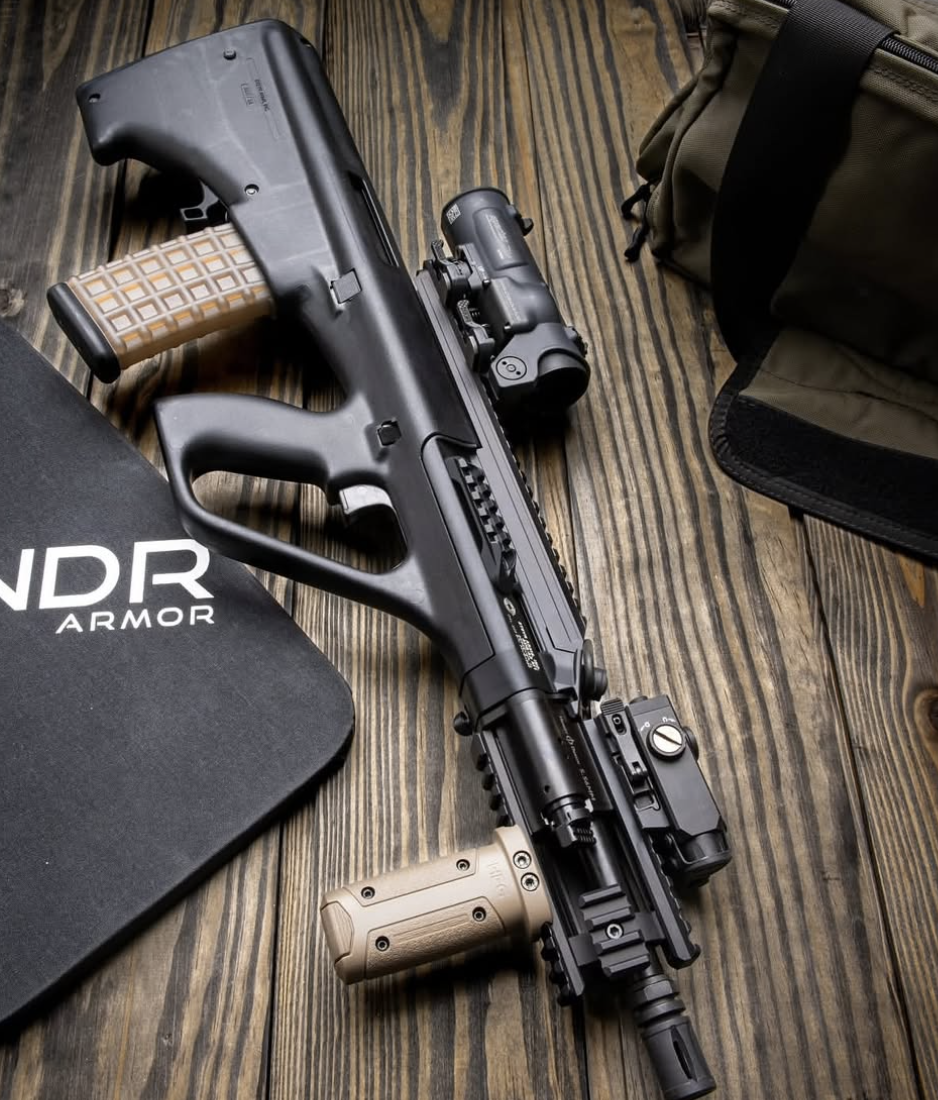
Let’s break down different comparisons of the Steyr AUG and the M4 Carbine to see what sets them apart.
1. Historical Background
Steyr AUG (Armee-Universal-Gewehr):
Developed in Austria by Steyr-Daimler-Puch and adopted by the Austrian military in 1978, the AUG was one of the world’s first successful bullpup rifles. Designed with futuristic aesthetics and modular features well ahead of its time, the AUG aimed to serve as a universal infantry weapon, easily adaptable to different roles (rifle, carbine, SMG, LMG). It quickly became a standard service rifle in several countries and has seen action globally.
M4 Carbine:
The M4 is a shortened, lighter version of the M16A2 rifle, developed in the 1990s for the U.S. military. Built on the AR-15 platform and designed for close-quarters combat, it became the standard-issue carbine for U.S. forces and many NATO allies. Its widespread adoption is due in part to its modularity, ease of use, and decades of development refinement.
2. Design and Ergonomics
Steyr AUG:
-
Bullpup Configuration: The AUG places the action and magazine behind the trigger, resulting in a much shorter overall length without sacrificing barrel length.
-
Length (overall): ~31.1 inches (with 20″ barrel)
-
Weight: ~8.8 lbs (with optic and loaded mag)
-
Trigger: Non-adjustable and relatively spongy compared to AR-style triggers.
-
Controls: Ambidextrous to a degree, but left-hand ejection requires a new bolt.
-
Integrated Optics: Early AUGs came with a built-in 1.5x scope, though modern models allow for rail-mounted optics.
M4 Carbine:
-
Conventional Layout: Standard rifle layout with the magazine in front of the trigger.
-
Length (overall): ~33 inches (with stock collapsed, 14.5″ barrel)
-
Weight: ~7.5 lbs (loaded with optics)
-
Trigger: Standard AR-15 trigger, easily upgradeable and generally crisp.
-
Controls: Fully ambidextrous options available in modern versions.
-
Picatinny/MLok Rails: Highly customizable with optics, lasers, lights, and grips.
3. Modularity and Customization

Image courtesy of Garand Thumb
AUG:
The AUG was modular before modularity was a trend. It features a quick-change barrel system and can be configured for different roles using factory parts. However, its proprietary design limits aftermarket support, especially compared to the AR platform in most cases.
Luckily, Heresy Design allows for large amounts of customization such as full blown conversion kits, so you can change your AUG to different calibers. You also can get things like silencer timing devices for your suppressors, new rail systems, and more. Check out Heresy Design for more AUG customization options.
M4:
The M4 dominates when it comes to modularity. Thanks to the vast AR-15 ecosystem, almost every part of the rifle can be swapped or upgraded—barrels, triggers, stocks, optics, handguards, and more. This makes the M4 platform ideal for customization to suit any mission or personal preference.
4. Accuracy and Performance
Steyr AUG:
The AUG is known for solid accuracy and consistent reliability. The bullpup design gives it the ballistic advantage of a full-length barrel in a compact form. However, the trigger, being part of a bullpup, is inherently less precise, which can slightly limit its precision potential.
M4:
The M4 offers excellent accuracy within typical engagement distances (100–300 meters), especially with upgraded barrels and triggers. While the shorter 14.5-inch barrel has slightly less velocity than the AUG’s average 20-inch, the difference is often negligible in close-quarters combat.
5. Reliability and Maintenance
AUG:
Built for rugged military use, the AUG is reliable in harsh conditions. Its enclosed design keeps dirt and debris out, and the gas-piston system runs clean. However, maintenance can be more complex due to the proprietary parts.
M4:
The M4, using a direct impingement gas system, runs dirtier than piston-driven rifles, which has been a historical criticism. That said, with proper maintenance, the M4 is extremely reliable. The abundance of spare parts and familiarity among users makes upkeep simple and cost-effective.
6. Magazine Compatibility
AUG:
Earlier models use proprietary translucent polymer magazines, though some variants like the AUG A3 M1 accept standard STANAG AR-15/M4 mags. This gives modern users more flexibility.
M4:
The M4 uses NATO-standard STANAG magazines, giving it broad compatibility and access to countless mag options, including drum mags, PMAGs, and extended capacity mags.
7. Price and Civilian Market Presence
Steyr AUG:
Civilian AUGs, such as the AUG A3 M1, are available in the U.S. but come at a premium—typically $2,000–$2,500. The cost, combined with proprietary parts and limited aftermarket support, makes it less common among casual shooters.
M4/AR-15:
The civilian AR-15 market is vast, with options from $500 budget builds to $3,000+ high-end tactical rifles. The platform’s popularity ensures endless parts availability, competitive pricing, and ease of maintenance.
8. Real-World Use and Deployment
Steyr AUG:
Still in service with several military forces, including Austria, Australia (as the F88), Ireland, and New Zealand. Known for its reliability, compact size, and rugged construction.
M4:
The M4 is the current standard-issue rifle of the U.S. military and is widely used by NATO and allied forces. Its battlefield performance, ease of training, and adaptability have made it a staple for modern armed forces.
Conclusion: Which Rifle Is Better?

There is no definitive “better” rifle—it depends entirely on the intended use:
-
Choose the Steyr AUG if you want a compact, reliable bullpup design that delivers full-length rifle performance in a short package. Ideal for urban environments and operators who prioritize length savings.
-
Choose the M4 if you want maximum modularity, ease of customization, and access to a massive ecosystem of parts and support. It’s a tried-and-true platform favored by military and civilian users alike.
Both rifles are battle-proven and represent different philosophies in firearm design. Whether you value the innovative bullpup engineering of the Steyr AUG or the classic, infinitely customizable AR platform of the M4, each rifle brings formidable capabilities to the table.
Check out Heresy Design on Instagram!


1 Comment
Vendetta™ Top Cover Rail Review | Heresy Design · December 30, 2025 at 8:38 am
[…] as M-LOK® compatible accessories. This modularity lets users tailor their firearm for competition, duty use, or recreational […]